Understanding Pueblo's Unique Soil Challenges
If you own property in Pueblo, you've likely noticed that concrete doesn't last as long here as it might in other parts of Colorado. The culprit isn't poor installation or cheap materials alone. It's the ground itself. Pueblo sits on a foundation of shale clay and sulfate-rich soils that create an unusually hostile environment for concrete. These soil conditions are natural to the region, but they demand specialized knowledge and materials when building or maintaining any concrete structure.
Shale is a sedimentary rock that breaks down into fine clay particles when exposed to moisture and freeze-thaw cycles. Sulfates, naturally occurring minerals in the soil, react chemically with concrete over time. When water infiltrates the concrete and carries these sulfates deeper into the slab, they trigger an expansion process that pushes from within. Homeowners often assume their driveway is simply aging, when in reality, the soil beneath is actively working against the concrete's structural integrity. Understanding this dynamic is the first step toward protecting your investment.
How Expansive Clay Causes Concrete Damage in Pueblo
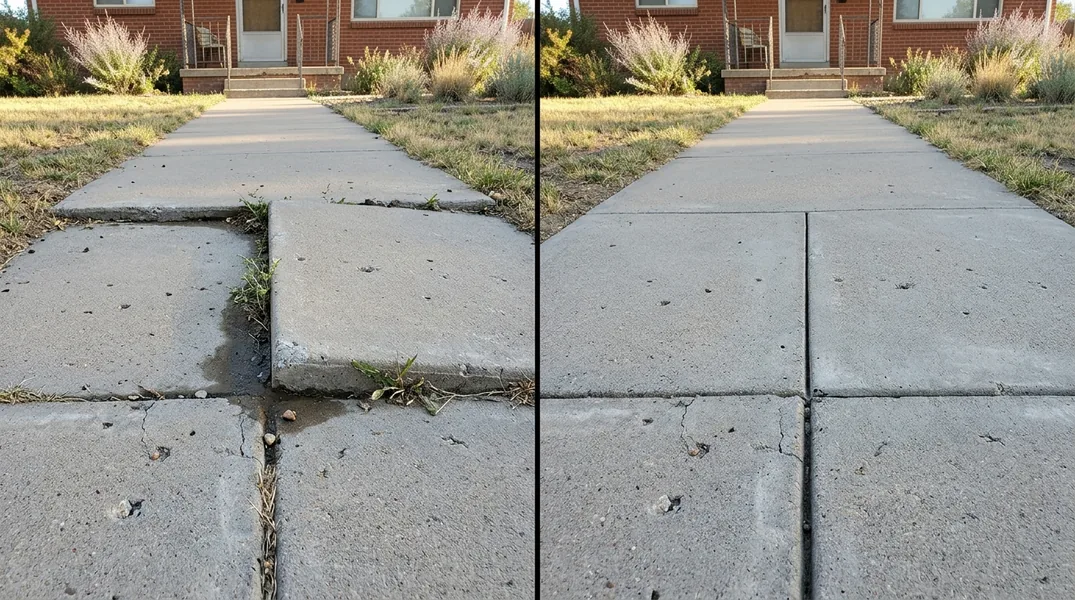
Expansive clay, also called montmorillonite clay, is the primary driver of concrete repair calls in our region. This clay swells dramatically when wet and shrinks when dry. During Pueblo's rainy seasons and spring snowmelt, water saturates the soil beneath your driveway. The clay expands upward, pushing on the concrete slab with tremendous force. When the soil dries out in summer, the clay contracts, creating voids and uneven settling. This cycle repeats year after year, causing the familiar cracks, heaving, and buckling that plague driveways throughout the area.
The damage pattern from expansive clay is distinctive. You'll often see diagonal cracks radiating from the center of a slab, or a driveway that appears to have sections pushed up higher than others. Corners and edges are particularly vulnerable because they receive less weight and protection. In severe cases, the entire slab can tilt or settle unevenly, creating trip hazards and making it difficult to park vehicles. Once expansive clay damage starts, it accelerates. Water finds its way into cracks, reaches the soil below, and intensifies the expansion cycle. This is why early intervention through Concrete Repair & Resurfacing can save thousands in replacement costs later.
Sulfate Attack: The Chemical Threat Beneath Your Driveway
While expansive clay creates mechanical damage through physical force, sulfates pose a different but equally serious threat. Sulfate attack is a chemical process that degrades concrete from within. Sulfates in the soil dissolve in groundwater and penetrate the concrete. Once inside, they react with the cement paste, forming new compounds that expand and weaken the structure. This process is slow but relentless, often going unnoticed until significant damage has occurred. Many homeowners discover sulfate damage only after cracks have spread or the surface has begun to spall and deteriorate.
The challenge with sulfate damage is that it doesn't announce itself with dramatic heaving or obvious displacement. Instead, you'll notice the concrete surface becoming rough and pitted, or sections crumbling away in small chunks. The edges of driveways are often hit first because water pools there and sulfate-laden soil moisture has easier access. Unlike expansive clay damage, which responds to moisture cycles, sulfate attack is a one-way chemical reaction. Once it begins, only prevention through proper materials and installation can slow or stop it. This is why choosing sulfate-resistant concrete is not optional in Pueblo but rather a fundamental requirement for durability.
Why Standard Concrete Fails in Pueblo Soil
You might wonder why concrete fails so consistently in Pueblo when it performs well elsewhere. The answer lies in the interaction between standard concrete mixes and our region's specific soil conditions. Regular concrete is designed with a cement paste that, while strong in compression, is vulnerable to sulfate penetration and the expansion forces created by clay movement. Standard concrete also tends to be more porous, allowing water and dissolved sulfates to travel deeper into the slab more quickly.
Additionally, many contractors who work across different regions use the same concrete specifications everywhere. They don't account for the particular challenges of shale clay and sulfate-rich soils. This one-size-fits-all approach fails in Pueblo. The concrete may look and feel solid for the first few years, but as moisture penetrates and chemical reactions begin, the damage accelerates. Homeowners often blame poor workmanship when the real issue is that the material itself wasn't formulated to withstand local soil conditions. A contractor familiar with regional challenges knows to specify sulfate-resistant cement, proper air entrainment, and strategic reinforcement to combat these forces.
Sulfate-Resistant Concrete: The Solution for Pueblo Driveways
The good news is that sulfate-resistant concrete exists and performs dramatically better in Pueblo's soil environment. Sulfate-resistant cement contains lower levels of tricalcium aluminate (C3A), the compound most vulnerable to sulfate attack. This specialized cement resists the chemical reaction that causes deterioration. When combined with proper water-to-cement ratios, air entrainment (tiny air bubbles that allow water to expand without cracking), and adequate thickness, sulfate-resistant concrete can last 30, 40, or even 50 years in our region instead of 10 to 15.
Beyond the cement type, proper installation practices matter enormously. Concrete should be placed over a compacted base, with drainage considerations to prevent water from pooling and saturating the soil beneath. The slab needs adequate thickness (typically 4 to 6 inches for driveways) and proper reinforcement to distribute stress. Finishing techniques also play a role. A properly troweled surface sheds water more effectively than a rough finish. When you invest in Concrete Driveways built to withstand Pueblo's conditions, you're choosing materials and methods proven to resist both expansive clay and sulfate attack. This is why working with a local contractor who understands these challenges is essential.
Protecting Your Concrete Investment: Maintenance and Repair Options
If your driveway already shows signs of damage from expansive clay or sulfate attack, several options exist depending on the severity. Minor cracking can be sealed to prevent water infiltration and slow further deterioration. Sealers create a barrier that reduces the rate at which moisture and sulfates penetrate the concrete. For more significant damage, Concrete Repair & Resurfacing can extend the life of your slab by 10 to 15 years. This might involve grinding the surface, filling cracks, and applying a protective overlay or coating.
For severely damaged driveways, replacement is sometimes the most cost-effective long-term solution. When you replace a driveway in Pueblo, insist on sulfate-resistant concrete and ensure the contractor addresses drainage and soil preparation. Many homeowners also choose to upgrade to Stamped & Decorative Concrete during replacement, combining durability with aesthetic appeal. Whatever path you choose, the key is acting before minor damage becomes catastrophic. Cracked concrete continues to deteriorate, and the longer you wait, the more expensive the final repair becomes. If you're concerned about your driveway's condition, contact Pueblo Concrete at (719) 467-2256 to schedule a free estimate. Our team understands the specific challenges of Pueblo's soil and can recommend the best solution for your property.
Looking for a professional concrete contractor in Pueblo? Pueblo Concrete responds fast for all your concrete needs.
Get a Free QuoteOur services: Concrete Driveways · Concrete Patios · Stamped & Decorative Concrete